2. Compare with a baseline and apply the gate
A calibration is judged twice: against raw DISP (does it help at all?) and against a baseline, the released algorithm (is the new one at least as good?). This tutorial uses the demo from tutorial 1.
Point a candidate at its baseline
demo/configs/half.yaml differs from perfect.yaml in three lines:
label: half
candidate_dir: .../demo/half          # this candidate's DISP-CAL products
baseline_dir: .../demo/runs/perfect   # the baseline's validation folder
baseline_dir is the output folder of the baseline's own run, not its
products. Run the baseline first.
disp2vlm-validate run --config demo/configs/half.yaml
disp2vlm-validate run --config demo/configs/none.yaml
F99999 half: FAIL
  - DD sill up +265.8% [95% CI +152.2, +628.8] vs baseline (limit 5%)
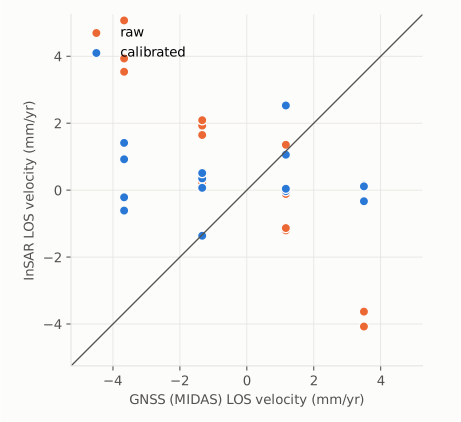
  - velocity RMSE up +1.90 mm/yr vs baseline (limit 0.2)
  - velocity |median bias| up +0.37 mm/yr vs baseline (limit 0.2)
F99999 none: FAIL
  - DD sill not reduced by calibration (8.1 vs raw 8.1 mm²)
  - DD sill up +781.4% [95% CI +577.5, +2390.2] vs baseline (limit 5%)
  - velocity RMSE up +4.78 mm/yr vs baseline (limit 0.2)
  - velocity |median bias| up +0.46 mm/yr vs baseline (limit 0.2)
The rules behind the verdict
disp2vlm-validate gate prints them; the numbers live in one place,
disp2vlm_validation.requirements.GATE.
| Rule | Fails when | half |
none |
|---|---|---|---|
| GATE-1 | the calibrated DD sill is not below raw | 3.37 < 8.12 ✓ | 8.12 = 8.12 ✗ |
| GATE-2 | the sill rises more than 5% vs baseline and the 95% bootstrap interval excludes zero | +266% ✗ | +781% ✗ |
| GATE-3 | velocity RMSE vs MIDAS rises more than 0.2 mm/yr vs baseline | +1.90 ✗ | +4.78 ✗ |
| GATE-3 | velocity |median bias| rises more than 0.2 mm/yr vs baseline | +0.37 ✗ | +0.46 ✗ |
The sill comparison is paired: raw, candidate and baseline share the same bootstrap resamples of stations, so their difference has a tight interval even when each sill alone is uncertain. A rise that is not significant does not fail.
The velocity rules use only stations outside deforming areas and event footprints (decision 0002): inside them, a 50 km calibration surface is expected to differ from a point measurement, and per-class targets judge them instead.
Per-class targets: notes or gates
A frame can add targets for station classes in a gate.yaml. The demo's:
per_class_targets:
  stable: {max_abs_bias_mm_yr: 1.0, max_rmse_mm_yr: 1.0}
By default a target is reported: a miss becomes a note in metrics.json
and the report, not a FAIL. For half:
"notes": ["stable: RMSE 2.26 > 1 mm/yr"]
A frame's benchmark condition gates instead (gating: true). Copy the
gate and the config, and make the stable class gating:
# demo/configs/gate_gating.yaml
per_class_targets:
  stable: {max_abs_bias_mm_yr: 1.0, max_rmse_mm_yr: 1.0, gating: true}
F99999 half-gating: FAIL
  ...
  - stable (benchmark condition): RMSE 2.26 > 1 mm/yr
Real frames use evidence-based targets rather than fixed numbers. Houston's,
for example, requires the subsiding class RMSE to stay below
sqrt(raw² + reference²), where the reference error is the GNSS grid's own
accuracy from trade study TS-G1:
per_class_targets:
  subsiding: {max_abs_bias_mm_yr: 1.0, rmse_must_drop_vs_raw: true,
              reference_rmse_mm_yr: 4.23, gating: true}
All target fields: Configuration.
Next: validate a real OPERA frame.